Buy Online
Add to Cart Now
Your shopping cart is empty!
Lorem Ipsum is simply dummy text of the printing and typesetting industry.
Globally certified & registered manufacturer
Globally trusted & secured payment methods
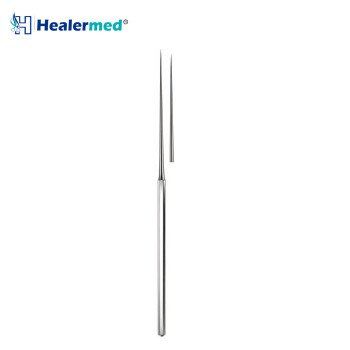
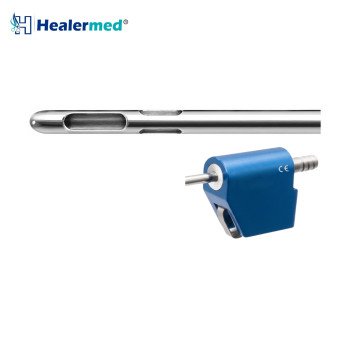
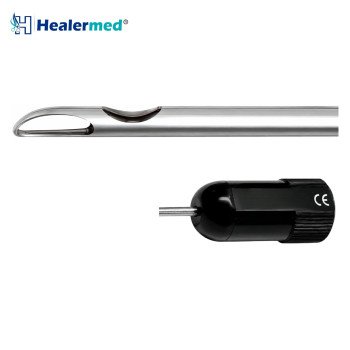
The MicroAire PAL Compatible Angled Tumescent Infiltration Cannula is a blunt-tip cannula with a bent working shaft and a hub built to fit MicroAire PAL power-assisted handpieces. Power-assisted infiltration drives the cannula in a short reciprocating stroke so it advances with far less force, while the angle lets the powered handpiece stay clear of a curved skin surface. See the full Angled Tumescent Infiltration Cannulas range for other fittings.
Buyers also search for this instrument as a power-assisted angled cannula, a PAL compatible bent infiltrator, or a reciprocating tumescent cannula.
At a Glance
Power-assisted infiltration changes how force reaches the tissue. Instead of the surgeon pushing the cannula through the plane, the handpiece drives a short, fast reciprocating stroke and the cannula advances with far less applied force. A powered handpiece is also bulky in the hand, so an angled shaft keeps it off a curved surface while the working section stays in the plane.
An angled cannula has a bend in the shaft, so the working section travels at an angle to the hub axis instead of running straight back from it. That changes the direction of the pass itself, which is the difference between an angled cannula and a bayonet one: a bayonet steps the shaft sideways and then runs parallel again, while an angle redirects where the tip actually goes.
The practical gain is reach. The body is curved, and a straight cannula entering a flank, hip or submental area has to be forced to an awkward wrist position to stay in the subcutaneous plane as the surface falls away. An angled shaft follows that curve instead of fighting it, so a single entry port covers more area and the surgeon's wrist stays in a neutral position through the pass.
The second gain is clearance at the skin. Because the hub sits at an angle rather than flat against the surface, the syringe or handpiece is held up and away from the area being filled. The surgeon is not pressing on tissue that is in the middle of taking up solution, which makes it easier to read turgor as the endpoint approaches.
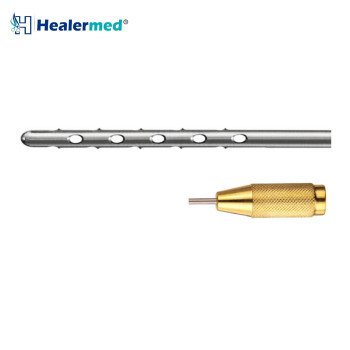
The distal tip is closed and rounded. It separates the subcutaneous plane by blunt dissection as the cannula advances, pushing vessels and nerves aside rather than dividing them, and side holes along the working section release the solution along the length of the pass rather than at one point.
| Material | German stainless steel |
| Fitting | MicroAire PAL compatible hub |
| Shaft shape | Angled — working section bent away from the hub axis |
| Tip | Closed blunt tip with side holes |
| Diameters | 1.0mm (19G), 1.1mm (19G), 1.2mm (18G), 1.4mm (17G), 1.5mm (17G), 1.6mm (16G), 1.8mm (15G), 2.0mm (14G), 2.4mm (13G), 2.5mm (13G), 3.0mm (11G), 3.5mm (10G), 4.0mm (8G), 4.5mm (7G), 5.0mm (6G), 6.0mm (4G) |
| Lengths | 3, 4, 5, 7, 7.5, 8, 9, 10, 12, 14, 15, 20, 25, 30, 35cm (by diameter) |
| Reusable | Yes — steam autoclavable to 134°C |
| Custom sizes | Available on request |
| Compliance | FDA CGMP, ISO 13485, ISO 9001, CE Mark |
The cannula is made from German stainless steel with a passivated surface that resists corrosion and pitting through repeated cleaning cycles. It is reusable and can be steam autoclaved at 134°C. Flush the lumen and every side hole with clean water immediately after use and dry fully before autoclaving. On an angled cannula, flush from both ends: any bend in a lumen is where residue settles first, and a partly blocked shaft changes how the solution distributes on the next case.
Order this fitting only if you already own a PAL power-assisted handpiece; the hub will not fit a syringe or a manual handle. Diameter sets the flow rate and length sets the reach. For large body areas such as the abdomen, flanks and thighs, the 2.5mm to 4.0mm diameters in 25cm to 35cm are the usual working range, because they fill a large area in fewer passes. The 1.8mm to 2.5mm range in 15cm to 25cm suits arms, the neck and smaller regions, where the angle earns the most because the surface curves sharply. The 1.0mm to 1.5mm diameters in 5cm to 12cm are for facial and submental infiltration. Match the fitting to the syringe, pump or handpiece already in your theater.
Buying for your practice? Order online at factory-direct prices, straight from the manufacturer — no distributor markup.
Distributor, importer, or hospital group? Get bulk pricing, OEM manufacturing, and custom branding on the full cannula range.
Manufactured by Healermed Instruments, a surgical instruments manufacturer and exporter based in Sialkot, Pakistan. Factory-direct pricing removes the importer and distributor layer. Production runs under an ISO 13485 and FDA CGMP quality system, with ISO 9001 and CE Mark certification. OEM manufacturing and custom branding are available for distributor and brand-owner orders.
Trademark notice: MicroAire and PAL are trademarks of MicroAire Surgical Instruments LLC. Healermed Instruments is not affiliated with, endorsed by, or sponsored by MicroAire. This cannula is an independently manufactured instrument and the compatibility reference is provided for the buyer's guidance only.
Other fittings in the same cannula range:
What is a power-assisted angled infiltration cannula used for?
It is used to deliver tumescent or wetting solution into subcutaneous tissue when the cannula is driven by a reciprocating handpiece instead of by hand. The powered stroke advances the cannula through fibrous tissue with less applied force, and the angled shaft keeps the handpiece clear of a curved surface.
What is the difference between an angled cannula and a straight cannula?
An angled cannula has a bend in the shaft, so the working section travels at an angle to the hub; a straight cannula runs in one line. The angle lets the cannula follow a curved body surface and stay in the subcutaneous plane without the surgeon twisting the wrist. A straight cannula is simpler to clean and store.
Is this cannula autoclavable?
Yes. The instrument is fully reusable and can be steam autoclaved at 134°C. Flush the lumen and every side hole with clean water immediately after use, remove all residue before sterilization, and dry completely. Flush from both ends so nothing is left sitting in the bend, where residue collects first.
What is the minimum order quantity for bulk orders?
The minimum order quantity is agreed per order rather than set at a fixed number. Send us the sizes, fittings and quantities you need through the wholesale request page and we will confirm the minimum for that specification. This lets a small distributor start with a trial order and a larger importer scale up on the same terms.
Do you provide samples?
Yes. Samples are available on request and the buyer covers the shipping charges. Send us your handpiece details with the diameter and length you want to evaluate. Testing a sample in your own handpiece before a bulk order is strongly recommended for any powered fitting.
Can I order a custom size?
Yes. Custom diameters, working lengths, bend angles and hole patterns are available on request in addition to the standard size grid. Send your specification through the wholesale request page and our production team will confirm what can be produced. Custom branding is also available for distributor and OEM orders.