Buy Online
Add to Cart Now
Your shopping cart is empty!
Lorem Ipsum is simply dummy text of the printing and typesetting industry.
Globally certified & registered manufacturer
Globally trusted & secured payment methods
The Davis Nasal Projectometer is a reusable stainless steel measuring instrument used in rhinoplasty to measure nasal projection, dorsal height and the nasolabial angle against a fixed facial reference plane. It is also searched for as a nasal projectometer, rhinoplasty projectometer, nasal projection meter, nose projection measuring instrument or Davis projection gauge. The instrument was developed with Richard Davis, MD, and takes readings at four separate landmarks — radix, rhinion, tip and the nasolabial angle — each on its own independently locking graduated arm.
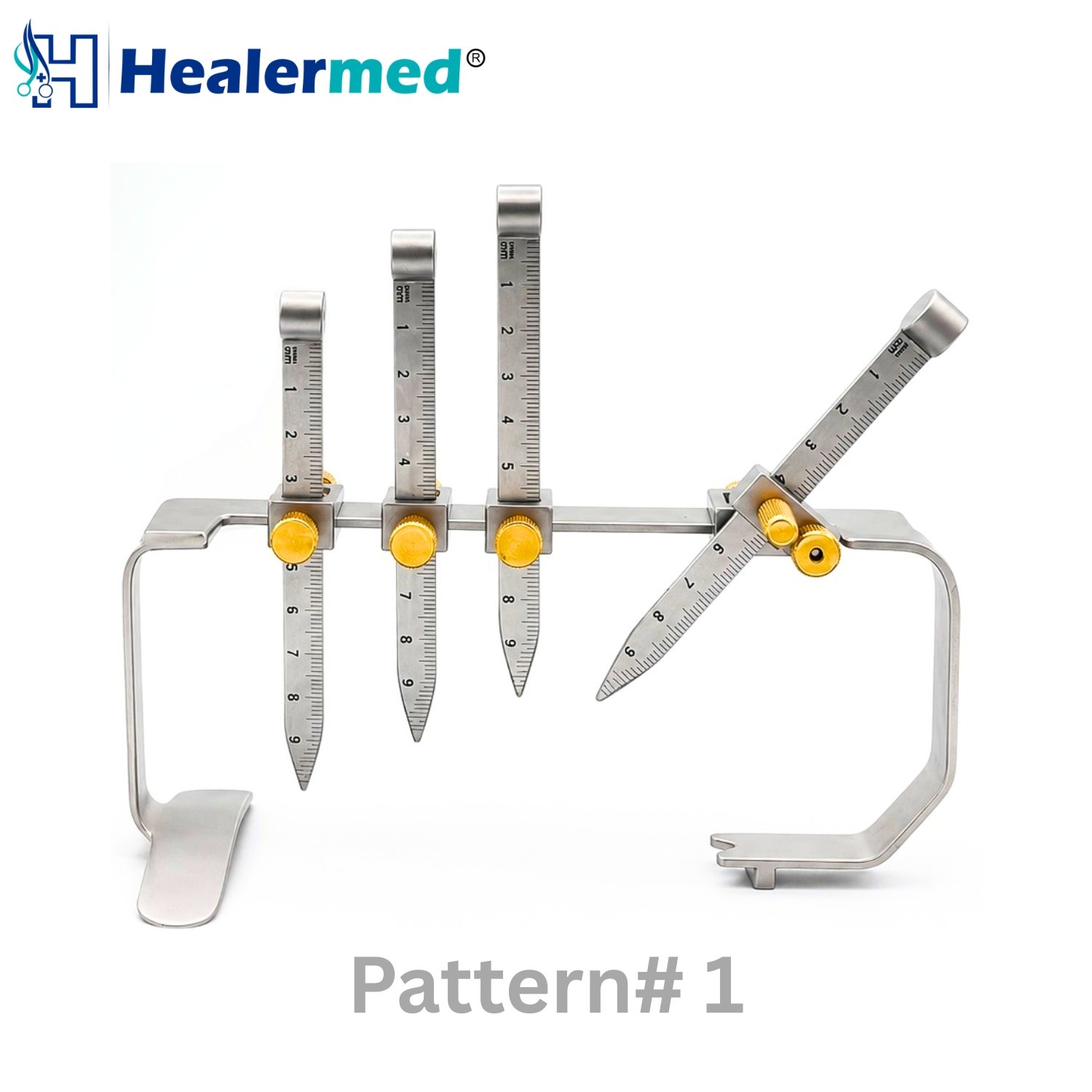
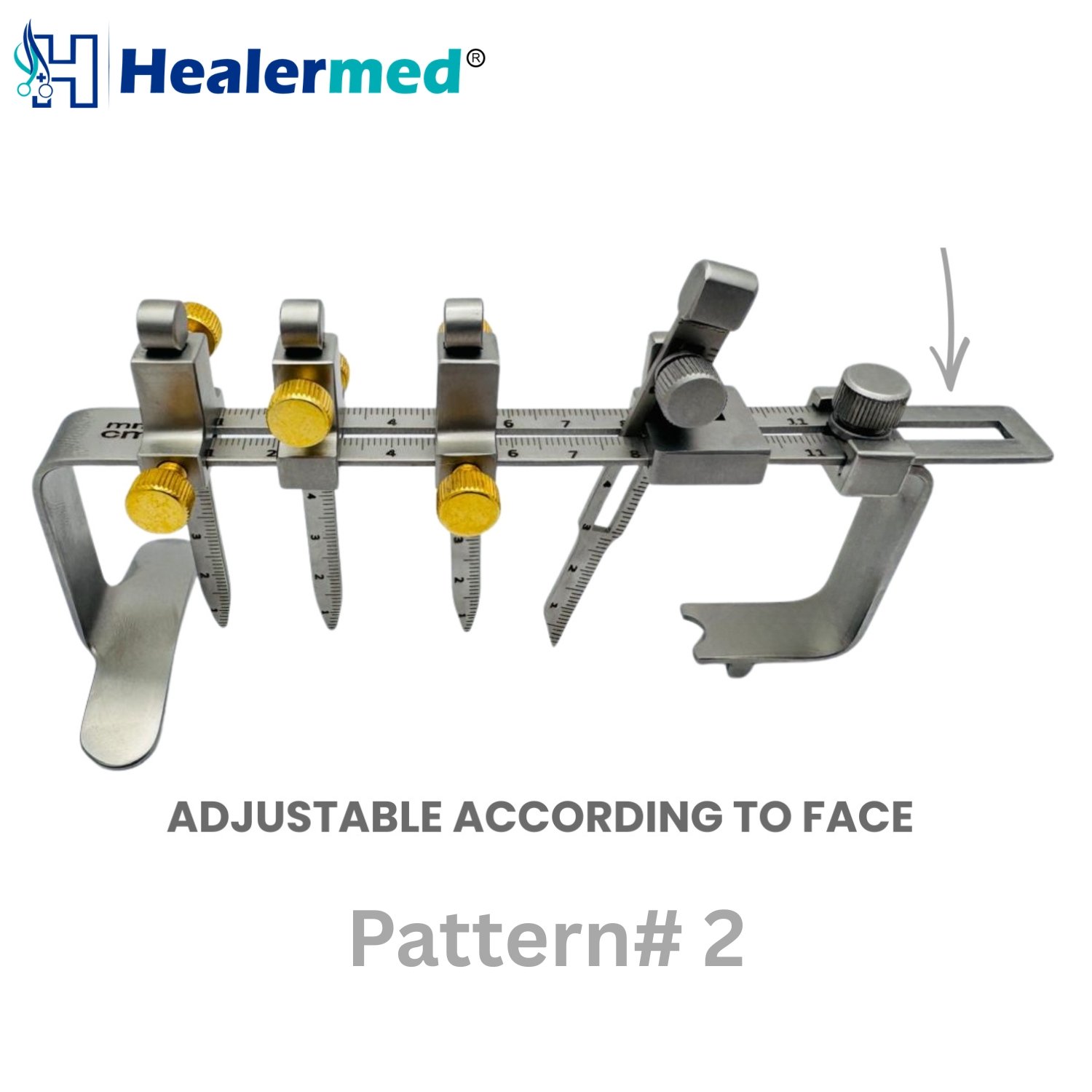
It replaces free-hand caliper work and visual estimation with numbers a surgeon can write down, repeat and compare. Because the frame registers against the forehead and the upper incisors, every reading is taken from the same skeletal baseline, so a pre-operative measurement, an on-table measurement and a follow-up measurement are directly comparable. Healermed Instruments supplies it in two patterns — Pattern 1 with a fixed frame, and Pattern 2 with an adjustable frame and a centimetre scale on the top bar. Both are the same instrument in material, finish and measuring points.
| Pattern 1 — Fixed | Pattern 2 — Adjustable | |
| Frame | Fixed span. The instrument seats the same way on every patient, so setup is quick and there is one less variable to set. | The span slides and locks, so the instrument is sized to the individual face before any reading is taken. |
| Top bar | Graduated in centimetres and millimetres, so the horizontal position of every arm is recorded as a number, not judged by eye. | Graduated in centimetres and millimetres, so the horizontal position of every arm is recorded as a number, not judged by eye. |
| Everything else | Identical — same four measuring points, same graduated arms, same tilting nasolabial pin, same notched forehead base and dental stop, same stainless steel and satin finish. | |
| Choose it if | You want the fastest, most repeatable setup on a consistent adult caseload. | Facial dimensions vary widely across your patients, or you need readings a colleague can reproduce exactly for teaching, audit or research. |
Select your pattern from the option above before adding to the cart. Departments that operate across a wide patient range often stock both, using Pattern 1 as the everyday instrument and Pattern 2 for atypical anatomy and documented cases.
| Instrument name | Davis Nasal Projectometer |
| Instrument type | Measuring and marking instrument, non-invasive, reusable |
| Specialty | Rhinoplasty, facial plastic surgery, ENT, craniofacial surgery |
| Patterns available | Pattern 1 (fixed frame) and Pattern 2 (adjustable frame with cm scale on top) |
| Measuring points | 4 — radix, rhinion, tip, nasolabial angle |
| Scale | Dual millimetre and centimetre graduations, etched into the steel |
| Facial references | Notched forehead base and forked dental stop |
| Adjustment | Independent locking on each arm; gold-tone knurled thumbscrews, no tools required |
| Material | Surgical grade stainless steel, satin non-glare finish |
| Sterilization | Supplied non-sterile; fully autoclavable and reusable |
| Manufacturer | Healermed Instruments, Sialkot, Pakistan |
| Certifications | ISO 13485, ISO 9001, CE Mark, FDA CGMP, EUDAMED, EU REX |
Nasal projection is how far the nose extends forward from the plane of the face. It is one of the figures that decides whether a rhinoplasty result looks balanced. Both patterns convert that anatomy into four independent readings:
| Landmark | What the reading tells the surgeon |
| Radix | Depth and vertical position of the nasal starting point. Sets the reference for dorsal line planning and radix grafting. |
| Rhinion | Dorsal height at the bony-cartilaginous junction. Shows how much hump reduction or dorsal augmentation is actually required. |
| Tip | Tip projection from the facial plane. The figure behind projection-increasing or de-projection manoeuvres. |
| Nasolabial angle | Columellar-labial relationship, taken with the tilting angled arm. The check on tip rotation and columellar show. |
Machined from surgical grade stainless steel with a satin, non-glare finish that will not throw light back at the surgeon under theatre lamps. Slides and thumbscrews are set to move smoothly without play, because a measuring instrument with loose joints cannot be trusted. Scale accuracy and slide action are checked on every unit before dispatch.
The Davis Nasal Projectometer sits in our measuring instruments range, alongside calipers, gauges and marking instruments. It is also stocked by surgeons working across our wider plastic surgery instruments and ENT surgical instruments catalogues, since nasal assessment crosses both specialties.
Healermed Instruments manufactures and exports surgical instruments from Sialkot, Pakistan, supplying surgeons, hospitals, distributors and OEM partners worldwide.
Certifications: ISO 13485, ISO 9001, CE Mark, FDA CGMP, EUDAMED registered and EU REX (European Commission Registered Exporter). Documentation is available on request.
Buying one or two for your own practice
Select Pattern 1 or Pattern 2 from the option above and add it to the cart. Single units ship worldwide with tracking, and laser engraving with a clinic or surgeon name is available on request.
Buying in volume, reselling, or need your own brand on it
Healermed Instruments supplies wholesale, private label and OEM production, including instrument marking, custom packaging and pattern modifications made to your drawing. Use the enquiry form on this page to request bulk and OEM pricing.
What is a Davis Nasal Projectometer used for?
It measures how far the nose projects from the facial plane, along with dorsal height at the radix and rhinion and the nasolabial angle. Surgeons use it to plan rhinoplasty, verify changes during surgery, and document results afterwards.
What is the difference between Pattern 1 and Pattern 2?
Pattern 1 has a fixed frame and a plain top bar. Pattern 2 has an adjustable frame that can be sized to the individual face, and a centimetre scale on the top bar so the horizontal position of each measuring arm is recorded as a number. In every other respect the two are the same instrument.
Which pattern should I order?
Order Pattern 1 for the quickest setup on a consistent adult caseload. Order Pattern 2 if your patients vary widely in facial size, or if you need readings that a colleague can reproduce exactly.
Who invented the Davis Nasal Projectometer?
The instrument was developed with Richard Davis, MD, and carries his name. It is now produced by several surgical instrument manufacturers, including Healermed Instruments.
Is the Davis Nasal Projectometer autoclavable?
Yes. It is a fully reusable stainless steel instrument supplied non-sterile and withstands standard steam autoclave cycles. Loosen all thumbscrews before reprocessing.
Does it read in millimetres or centimetres?
Both. Every arm carries dual millimetre and centimetre graduations, etched into the steel so they do not wear off with repeated cleaning. On Pattern 2 the top bar is graduated as well.
How is a projectometer different from a caliper?
A caliper measures the distance between two points held by hand. A projectometer fixes the reference plane against the forehead and dentition first, so every reading is taken from the same skeletal baseline. That is what makes a pre-operative figure and an intra-operative figure directly comparable.
Can it be used outside the operating room?
Yes. It is used in clinic consultations for pre-operative assessment, at follow-up visits, and in academic settings for anthropometric measurement and outcome research.
Is it available for wholesale, private label or OEM supply?
Yes. Healermed Instruments manufactures under private label and OEM arrangements, including instrument marking, custom packaging and pattern modifications to a buyer's drawing.