Buy Online
Add to Cart Now
Your shopping cart is empty!
Lorem Ipsum is simply dummy text of the printing and typesetting industry.
Globally certified & registered manufacturer
Globally trusted & secured payment methods
Liposuction Cannulas and Accessories › Multiport Speed Harvester One End Sharp Liposuction Cannulas › Multiport Speed Harvester One End Sharp Liposuction Cannula – Super Luer Lock
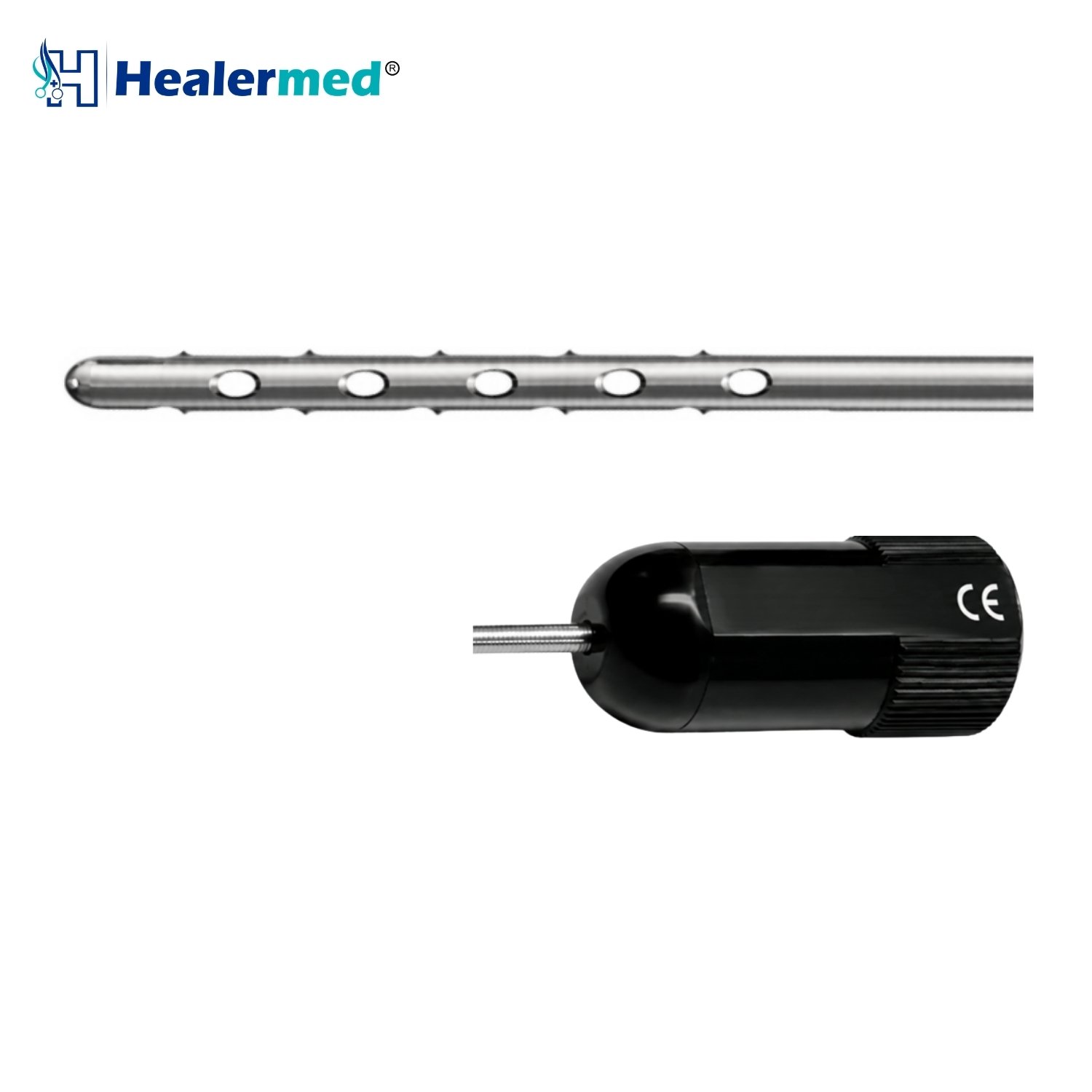
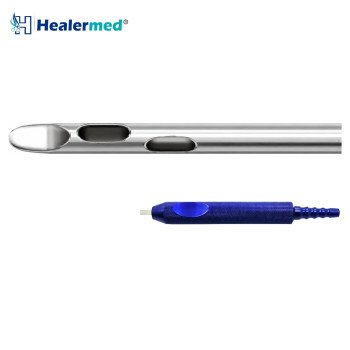
The Multiport Speed Harvester One End Sharp Liposuction Cannula with Super Luer Lock fitting is a multiport speed harvester with one port end sharp is a fat harvesting liposuction cannula whose ports carry a cutting edge on one end only, so the forward stroke harvests and the return repositions. It is listed under Multiport Speed Harvester One End Sharp Liposuction Cannulas, part of the Healermed Liposuction Cannulas and Accessories range.
Surgeons also search for these liposuction cannulas as fat harvesting cannulas, fat transfer cannulas, fat grafting cannulas, or multiport harvester cannulas.
At a Glance
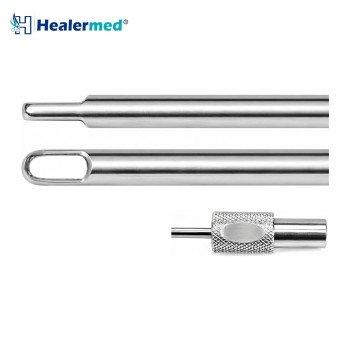
Aspiration speed is limited by the narrowest point in the suction path. If the hub is narrower than the opening in the shaft, the cannula never performs to its size. The Super Luer Lock bore keeps the shaft as the controlling factor, with a longer thread on a heavier body that holds under sustained vacuum.
This fat harvesting cannula carries multiple ports, each sharpened at one end only. An edge meets tissue on the forward stroke; on the return, the plain end passes without cutting.
That asymmetry is the design, not a saving. Harvesting with edges in both directions means the cannula is dividing tissue whichever way the hand moves, and the surgeon has little opportunity to feel resistance and respond to it. With one cutting direction, every pass has a working half and a passive half: the forward stroke harvests, the return repositions. The hand gets a moment on each cycle to read what the tissue is doing.
That matters on donor sites that are not uniform. Fibrous strands, a previously operated field, or a thin area near the edge of the harvest zone all reward a cannula the surgeon can feel through. A both-end-sharp harvester will already have cut a band before the resistance registers; a single edge lets the surgeon ease off, reposition and take the next pass differently.
Throughput sits between the two other specifications: faster than a beveled harvester, slower than both-end-sharp. It is the middle option, and for many surgeons it is the default harvester with the other two kept for extremes of donor site. The distal tip is closed and rounded and does not cut; the sharpened edge is on the ports only.
| Material | German stainless steel |
| Fitting | Larger bore, longer thread, heavier hub |
| Opening | Multiple ports, each sharpened at one end only |
| Tip | Closed blunt tip |
| Diameters | 1.0mm (19G), 1.1mm (19G), 1.2mm (18G), 1.4mm (17G), 1.5mm (17G), 1.6mm (16G), 1.8mm (15G), 2.0mm (14G), 2.4mm (13G), 2.5mm (13G), 3.0mm (11G), 3.5mm (10G), 4.0mm (8G), 4.5mm (7G), 5.0mm (6G), 6.0mm (4G) |
| Lengths | 3, 4, 5, 7, 7.5, 8, 9, 10, 12, 14, 15, 20, 25, 30, 35cm (by diameter) |
| Reusable | Yes — steam autoclavable to 134°C |
| Custom sizes | Available on request |
| Compliance | FDA CGMP, ISO 13485, ISO 9001, CE Mark |
The cannula is made from German stainless steel with a passivated surface that resists corrosion and pitting through repeated cleaning cycles. It is reusable and can be steam autoclaved at 134°C. Flush the lumen and the opening with clean water immediately after use and dry fully before autoclaving. Only one end of each port carries an edge, so identify which end it is and inspect those edges under magnification at every cycle. A dulled cutting edge tears rather than divides, and on a single-edge harvester the loss of performance is immediate because there is no second edge doing the work.
Diameter sets how much comes out per pass and length sets the reach. For harvesting from the abdomen, flanks and thighs, the 3.0mm to 4.0mm diameters in 25cm to 35cm are the usual working range. The 2.5mm to 3.0mm range in 20cm to 30cm suits smaller donor sites and facial grafting volumes. Choose the both-end-sharp version when throughput matters more than feel, or the both-end-bevel version when the parcels should be guided rather than cut. Match the fitting to the syringe, vacuum line or handpiece already in your theater.
Buying for your practice? Order online at factory-direct prices, straight from the manufacturer — no distributor markup.
Distributor, importer, or hospital group? Get bulk pricing, OEM manufacturing, and custom branding on the full cannula range.
Manufactured by Healermed Instruments, a surgical instruments manufacturer and exporter based in Sialkot, Pakistan. Factory-direct pricing removes the importer and distributor layer. Production runs under an ISO 13485 and FDA CGMP quality system, with ISO 9001 and CE Mark certification. OEM manufacturing and custom branding are available for distributor and brand-owner orders.
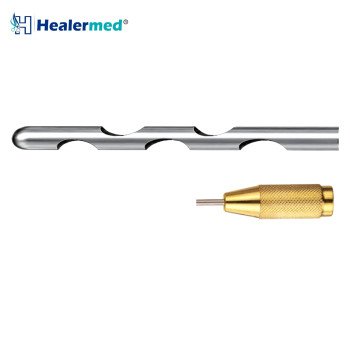
Healermed makes this multiport harvesting cannula in three port-edge specifications. They share the same shaft, the same port layout and the same size grid; only the edges differ, and that difference sets where each one sits between harvest speed and how gently each parcel is separated.
| Both End Sharp Separates parcels on the forward and the return stroke. Fastest fill. |
One End Sharp Separates on the forward stroke only. A reading stroke on every cycle. |
| Both End Bevel Guides parcels in along an incline. Least shearing at the port. |
Harvesting is a function of the cannula, not of the machine behind it. The pump or syringe supplies negative pressure, but what actually happens to the fat is decided at the openings in the shaft, and that is why one harvesting cannula collects a usable graft faster or more gently than another.
The sequence at each port is the same every time. The surgeon advances the cannula through the subcutaneous layer; tissue is drawn against an opening by the vacuum; the edge of that opening separates a parcel of fat from the surrounding tissue; and the parcel travels down the lumen to the syringe or canister. Repeat that a few hundred times across a donor site and you have a graft.
Three things about the cannula decide how that sequence goes. Port size sets how large each parcel is, which matters because the parcel has to pass through the lumen and then through whatever the graft is injected with. Port count sets how many parcels are separated per pass, which is throughput. Edge geometry — sharpened, part-sharpened or beveled — sets how the parcel is separated: divided cleanly, divided in one direction only, or guided in along an incline.
That last one is the choice most surgeons think hardest about, because harvested fat is going back into the patient. Every edge a parcel passes applies mechanical force to it. A cutting edge separates tissue quickly; an inclined edge leads it in with less shearing but takes longer through fibrous strands. Neither is correct in the abstract — the right answer depends on the donor site and on how much volume has to be collected before the case moves on.
Diameter and length are the remaining variables. A wider cannula moves more fat per pass but needs a larger access port and a deeper plane; a longer shaft covers more of the donor area from a single entry. Aspirated fat is thick, so the hub matters too: a narrow Luer taper will throttle a cannula that the shaft itself could keep supplied, which is why Toomey and Super Luer fittings are common on harvesting instruments.
Every fitting below carries the same multiport speed harvester one end sharp shaft, the same closed blunt tip and the same size grid. Pick the one that matches the syringe, vacuum line or handpiece already in your theater.
| Luer Lock Liposuction Cannula Standard Luer lock syringes and suction tubing |
Stainless Steel Luer Lock Liposuction Cannula All-steel hub for heavy autoclave cycles |
| Threaded Fitting Liposuction Cannula Threaded reusable handles and tubing connectors |
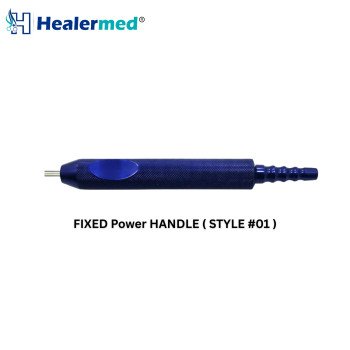
Fixed Power Handle Liposuction Cannula Integrated handle, permanently attached |
| Grooved Power Handle Liposuction Cannula Grooved grip for wet-glove control |
Black Power Handle Liposuction Cannula Black anodized, low glare under lights |
| Toomey Hub 60cc Liposuction Cannula 60cc Toomey-tip syringes, from 2.0mm up |
MicroAire PAL Compatible Liposuction Cannula MicroAire PAL power-assisted handpieces |
| Lumsail Compatible Liposuction Cannula Lumsail machine handpieces |
Universal Luer Lock Liposuction Cannula Fits Luer lock across syringe brands |
| Vibrasat Quick Lock Liposuction Cannula Vibrasat quarter-turn quick-lock coupling |
BeautiFill Laser Compatible Liposuction Cannula BeautiFill laser lipolysis handpieces |
Healermed manufactures the full range of cannulas for liposuction, from single hole finishing cannulas to high-flow debulking patterns, in 84 diameter and length combinations.
| Multiport Speed Harvester One End Sharp Liposuction Cannula All 13 fittings on one product page |
Multiport Speed Harvester One End Sharp Liposuction Cannulas The full multiport speed harvester one end sharp category |
| Liposuction Cannulas Every port pattern and cannula type we make |
Liposuction Accessories Handles, hubs and cannulas for liposuction |
What is a multiport speed harvester one end sharp liposuction cannula used for?
It is used to collect subcutaneous fat under vacuum for grafting and fat transfer. Ports sharpened at one end cut on the forward stroke while the return repositions, so the surgeon has a passive moment on every cycle to feel the donor tissue and adjust the next pass.
What is the difference between one-end-sharp and both-end-sharp harvesting cannulas?
A both-end-sharp harvester cuts on the forward stroke and the return, which is faster but gives the surgeon no passive moment to feel the tissue. A one-end-sharp harvester cuts on the forward stroke only, so every cycle has a working half and a reading half. It is slower and more controllable.
Is this cannula autoclavable?
Yes. The instrument is fully reusable and can be steam autoclaved at 134°C. Flush the lumen and the opening with clean water immediately after use, remove all residue before sterilization, and dry completely. Inspect the opening edge under light at every cycle, since edge condition decides how the cannula behaves in tissue.
Which size should I use?
For harvesting from the abdomen, flanks and thighs, 3.0mm to 4.0mm diameters in 25cm to 35cm are the usual range. Use 2.5mm to 3.0mm in 20cm to 30cm for smaller donor sites and facial grafting volumes. For maximum throughput choose the both-end-sharp version; for the gentlest cut choose both-end-bevel.
What is the minimum order quantity for bulk orders?
The minimum order quantity is agreed per order rather than set at a fixed number. Send us the sizes, fittings and quantities you need through the wholesale request page and we will confirm the minimum for that specification. This lets a small distributor start with a trial order and a larger importer scale up on the same terms.
Do you provide samples?
Yes. Samples are available on request and the buyer covers the shipping charges. Tell us the diameter and length you want to evaluate and we will confirm what can be sent. Testing a sample first confirms the hub seats correctly in your existing tubing set.
Can I order a custom size?
Yes. Custom diameters, working lengths and opening dimensions are available on request in addition to the standard size grid. Send your specification through the wholesale request page and our production team will confirm what can be produced. Custom branding is also available for distributor and OEM orders.